
What’s Inside
- The closed-loop factory
- From firefighting to prediction
- Use case: Predictive maintenance integration
- Use case: Demand-driven factory orchestration
- Use case: Continuous improvement automation
- Use case: Multi-site coordination
- The competitive divide
- The human role in the integrated fab
- What leading fabs are doing
- The path forward
Previous articles around Scheduling established the problem and the solution. Fab productivity tools operate in silos, forcing industrial engineers to serve as the integration layer. AI agents change that model by reasoning across systems, acting on that reasoning, and scaling beyond human limits.
This post looks forward: what does the integrated fab look like as these capabilities mature? It isn’t looking at theory, but the operating model emerging at leading-edge facilities today.
The closed-loop factory
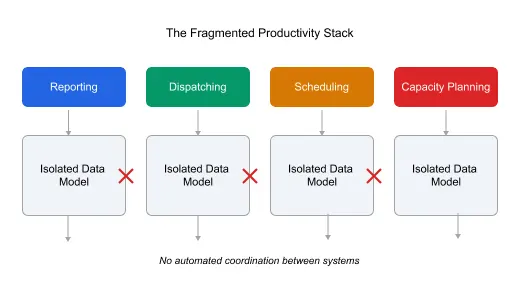
Today’s fab operates in open loops. Reporting observes execution, Scheduling plans production, Dispatch controls release, and Capacity Planning forecasts the future. Each system has inputs and outputs, but the loops don’t close. The integrated fab closes them. Reporting feeds anomalies to scheduling. Scheduling adapts from execution feedback. Dispatch receives real-time priority updates. Capacity planning ingests actual performance and refines projections continuously. AI agents orchestrate the flow. When a reporting anomaly appears, an agent assesses severity, determines scheduling impact, adjusts dispatch if needed, and updates capacity projections within a continuous loop. The human role shifts from executing the loop to supervising it.
The result is a fab that responds at machine speed because human judgment is encoded and executed consistently at scale.
From firefighting to prediction
Reactive operations are defined by surprise: problems appear, humans respond, and the best fabs simply respond faster than competitors. However, predictive operations flip the model in that problems are anticipated before they materialize and response happens before impact, as shown in Figure 1.
This requires rolling forecasts that ask: given where we are now, where will we be in four hours, eight hours, or tomorrow, and what interventions prevent problems before they escalate?
AI agents make those projections continuous. They update as new information arrives, identify emerging risks—a tool trending toward failure, WIP accumulating at a constraint, a capacity gap opening—and surface them before they become crises.
The shift is from “This tool went down, what do we do?” to “This tool will likely go down in eight to 12 hours; here’s the plan.”
Use case: Predictive maintenance integration
A shift like this takes into account that equipment failure is inevitable and moves the fab from a state of responding after failure to intervening before impact. Intervention is the important distinction. Prediction alone has limited value. Knowing a tool may fail tomorrow doesn’t help if Scheduling, Dispatch, and Capacity Planning don’t adjust.
Consider the scenario: sensors on a critical CVD tool show patterns that, historically, precede chamber degradation. The predictive model estimates 70% probability of failure within 36 hours.
In the fragmented fab, this triggers an alert and an IE assesses the situation. Maintenance is notified. Scheduling may or may not adjust depending on who sees what and when.
In the integrated fab, an agent receives the prediction and orchestrates the response. It identifies lots scheduled on the at-risk tool, evaluates backup equipment, models rerouting impact, adjusts the short-term schedule to minimize lots in flight during maintenance, updates dispatch priorities, recalculates capacity projections, and flags commits at risk.
The IE then reviews the assessment and approves or modifies it based on context the agent lacks. Either way, the response happens in hours, not days, and the failure is absorbed rather than disruptive.
Operations teams consistently report that unplanned equipment downtime carries significantly higher cycle time impact than planned downtime—often several times greater. The integrated fab converts unplanned events to planned responses systematically.
Use case: Demand-driven factory orchestration
When customer demand such as orders, commits, and forecast changes fluctuate, the factory must adapt quickly.
In the fragmented fab, demand changes trigger manual coordination across sales, planning, scheduling, and dispatch. Propagation takes days to weeks, with information degrading at each handoff.
For example: a key customer accelerates an order. They need 2,000 wafers delivered two weeks earlier than committed. Sales wants to say yes. Operations needs to know if it’s possible.
An agent traces the impact in minutes, examining current WIP, modeling whether the lots can be accelerated without displacing other commits, identifying tool groups that would need higher utilization, and projecting downstream effects on other orders.
Rather than providing a single answer, the agent returns options. Option A is to accept with high confidence, requiring weekend overtime on two tool groups and delaying order Y by three days. Option B is partial acceleration, with 75% of volume on the original timeline and 25% two weeks early, with no other order impact. Option C is to decline because the current plan is already constrained.
The decision remains human, but the analysis is instantaneous and consistent. Sales gets an answer in hours, not weeks. The customer gets options, not apologies.
Use case: Continuous improvement automation
Fabs improve through iteration: rules are tuned, parameters adjusted, and processes refined. The mechanism is usually human-driven, which limits how many improvement cycles can run.
The scenario: An agent observes a recurring pattern. Every Tuesday and Wednesday, WIP congestion develops at a specific tool group. The congestion correlates with product mix—when products A and C run simultaneously, downstream flow degrades.
A human might eventually notice the pattern, hypothesize a cause, test a change, and evaluate results, but the cycle could take months.
The agent identifies the pattern in days, correlates congestion with product mix, upstream release timing, and downstream tool availability, then proposes a hypothesis to adjust dispatch priorities for product A when product C volume exceeds a threshold.
Using historical data, the agent simulates what would have happened over the past 90 days and quantifies the expected impact: an 8% reduction in queue depth variability at the affected tool group.
An IE reviews the proposal, validates the logic, and approves the change. Elapsed time from pattern detection to implemented improvement: weeks, not months.
The agent continues monitoring and, if the rule underperforms, it flags the divergence for review. Continuous improvement becomes actually continuous, not periodic.
Use case: Multi-site coordination
Large semiconductor manufacturers operate multiple fabs, each with its own productivity stack, IEs, and optimization priorities. Cross-site coordination is often manual, from monthly reviews and spreadsheet-based load balancing, to calls when one site needs help. That leaves value on the table. One fab may have excess capacity while another is constrained, but the visibility and mechanisms to act are limited.
The scenario: Fab A is running at 105% of nominal capacity due to unexpected demand. Cycle times are stretching. Commits are at risk. Fab B, running similar products, has 15% available capacity.
Without cross-site integration, this imbalance might persist for weeks until the monthly planning review. Even then, load balancing is constrained by data latency and coordination friction.
With agent-based coordination, the imbalance is visible in real time. An agent identifies lots queuing at Fab A that could run at Fab B with minimal qualification effort, then models transfer time, process adjustments, and impact on Fab B’s schedule.
The recommendation surfaces immediately: transfer 400 lots to Fab B, reducing Fab A cycle time by two days while remaining within Fab B’s capacity envelope. Total network cycle time improves by 6% compared to letting each site optimize locally.
The decision requires human approval—logistics, customer implications, and site politics all factor in. But the analysis is instant, and the option is visible instead of hidden.
The competitive divide
The integrated fab isn’t a vision for 2030. It’s being built now by manufacturers that recognize operational advantage compounds over time. Fabs that integrate—closing loops, shifting from reactive to predictive, and using AI agents for cross-functional coordination—will respond to demand faster, absorb disruptions more gracefully, and retain institutional knowledge as experienced staff retire.
Fabs that don’t integrate will keep operating as they do today. That isn’t failure, but it means watching competitors pull ahead on cycle time and spending more on staffing to compensate manually for what technology could handle.
The gap will widen because organizations that deploy AI agents build operational muscle—processes, expertise, and culture adapted to AI-augmented operations. Starting later means catching up on both technology and organizational learning.
The human role in the integrated fab
Where do humans fit in a factory where AI agents orchestrate production? At the moment, IEs monitor, assess, intervene, and coordinate. It is cognitively demanding, and it doesn’t scale.
Tomorrow’s IEs supervise the factory. They set objectives, define constraints, handle exceptions beyond agent authority, review significant changes, and bring judgment to novel situations. This is an elevated role from executing routine decisions to governing how they get made; from solving today’s problems to designing systems that prevent tomorrow’s. The skill profile changes too. Future IEs need to understand AI capabilities and limitations, specify objectives rather than actions, and evaluate agent recommendations critically.
What leading fabs are doing
The integrated fab builds capability by capability, use case by use case. Leading manufacturers are taking practical steps now to:
- Unify data access so agents can reason across systems.
- Pilot bounded use cases such as WIP balancing or scheduling adjustments for a tool group.
- Capture decision rationale so agents can learn not just what IEs decide, but why.
- Redefine roles as routine coordination shifts from humans to agents.
- Select partners with both AI capability and semiconductor domain expertise.
These are pragmatic moves toward a capability that will define competitive position over the next decade.
The path forward
The fragmented fab is familiar. Its limitations are known, and its costs are absorbed.
The integrated fab is emerging. The choice isn’t whether AI agents will transform fab operations; that is already happening. The choice is whether your fab will help define the new model or catch up later. The technology is ready. The use cases are proven. The competitive window is open.
FAQs
How can AI agents help a semiconductor fab move from reactive to predictive operations?
AI agents help fabs anticipate issues by continuously analyzing data from scheduling, dispatch, equipment health, WIP, and capacity systems. Instead of waiting for a problem to disrupt production, agents identify emerging risks, model the operational impact, and recommend actions before cycle time, delivery commitments, or tool availability are affected.
What is a closed-loop fab, and why does it matter for semiconductor manufacturing?
A closed-loop fab connects planning, scheduling, dispatch, reporting, and capacity systems so each function continuously feeds the next. This matters because fab conditions change constantly. When feedback loops are connected, the factory can adjust priorities, reroute work, update forecasts, and respond to demand or equipment changes much faster than manual coordination allows.
How does predictive maintenance create more value when it is connected to scheduling and dispatch?
Predictive maintenance is most valuable when the fab can act on the prediction. If a tool is likely to fail, connected scheduling and dispatch systems can reroute lots, adjust priorities, plan maintenance, and update capacity projections. This turns a potential unplanned disruption into a coordinated response that protects throughput and customer commitments.
Can AI agents help semiconductor manufacturers respond faster to customer demand changes?
Yes. AI agents can evaluate demand changes against current WIP, tool availability, cycle time risk, capacity constraints, and existing commitments. Rather than relying on manual handoffs across sales, planning, and operations, the fab can quickly generate feasible options, understand tradeoffs, and decide whether to accelerate, partially fulfill, or decline a request.