
What’s Inside
- The inconvenient truth about AI differentiation
- Risk 1: Hallucination and confident errors
- Risk 2: Training data quality and bias
- Risk 3: Brittleness under novel conditions
- Risk 4: Compute costs and infrastructure requirements
- Risk 5: Organizational resistance and change management
- Risk 6: Security and adversarial concerns
- Risk 7: Regulatory and compliance uncertainty
- The human advantage
- Implementation best practices
- The differentiated fab
In other Scheduling-focused blogs, we made the case for AI agents as the integration layer in semiconductor manufacturing: fragmented fabs need intelligence that can reason across systems.
This article addresses what those discussions understate: the risks. AI adoption in fab operations is not plug-and-play, and the difference between success and disappointment often has little to do with algorithms.
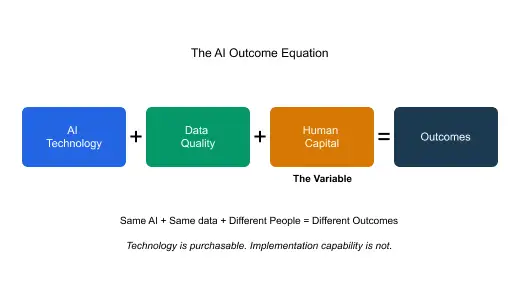
Two fabs with the same AI platform can get very different outcomes, as shown in Figure 1. The variable is human in terms of talent, implementation quality, organizational readiness, and disciplined risk management.
The inconvenient truth about AI differentiation
AI is not a commodity, but the ability to use it effectively in a specific operational context depends on the human interactions. Consider two hypothetical fabs deploying the same AI-enabled scheduling platform:
Fab A has industrial engineers who understand both process behavior and AI limitations. They define objectives clearly, set constraints, validate outputs, and treat AI as a tool that amplifies expertise.
Fab B was told AI would solve its problems. It accepted vendor defaults, has gaps in training data, and lacks processes for validating agent decisions.
The same technology in two scenarios produced different outcomes. Fab A’s agents improve through feedback; Fab B’s stagnate or degrade. AI implementation is a skill the industry is still developing, and there are some inherent risks.
Risk 1: Hallucination and confident errors
AI models can generate plausible-sounding outputs that are wrong. In operational AI, that appears as recommendations based on faulty reasoning, incomplete pattern matching, or constraints the model was never trained to recognize. A scheduling agent might optimize lot sequence for throughput while violating a hidden constraint. A dispatch agent might rebalance WIP in a way that makes sense locally but creates downstream problems, and a predictive model might flag a tool for maintenance based on a correlation that reflects a different root cause. The danger is not that errors occur; they will. The danger is that AI systems express confidence whether they are right or wrong.
Some recommended mitigation strategies include:
- Confidence calibration: Require uncertainty bounds, not just point recommendations.
- Human review gates: Define thresholds for autonomous action versus human approval.
- Anomaly detection on inputs: Flag conditions outside the training distribution.
- Outcome tracking: Compare predictions to actual results to detect calibration drift.
Risk 2: Training data quality and bias
AI agents learn from data. If the data is incomplete, biased, or unrepresentative, the agent encodes those limitations. This can result in:
Historical bias: Data from a specific product mix, equipment configuration, or operating condition can cause poor performance when those conditions change, such as moving from high-volume production to a high-mix ramp.
Survivorship bias: Training data captures what happened, not the alternatives IEs considered and rejected, so the model can miss optimization opportunities outside recorded decisions.
Labeling inconsistency: If similar situations were labeled differently, the model learns conflicting patterns.
Missing edge cases: Rare events—major equipment failures, unprecedented product issues, supply disruptions—are often underrepresented, even though they are where guidance would be most valuable.
To mitigate these risks, IEs should consider:
- Data audits: Characterize time periods, operating conditions, gaps, and known limitations before training.
- Synthetic augmentation: Use synthetic examples for underrepresented scenarios but validate realism.
- Continuous learning with guardrails: Update models with new data while monitoring distribution shift and degradation.
- Expert review: Have experienced IEs assess training samples for completeness and consistency.
Risk 3: Brittleness under novel conditions
- Novelty detection: Trigger human review when current conditions differ meaningfully from training data.
- Graceful degradation: Allow agents to say, “I don’t have high confidence in this situation.”
- Modular architectures: Update product- or equipment-specific components without retraining the entire system.
- Regular retraining cycles: Refresh models as operational context evolves.
Risk 4: Compute costs and infrastructure requirements
AI is not free; inference compute, training infrastructure, storage, networking, and real-time integration all have production-scale costs. Foundation models are computationally expensive, especially at the frequency required for real-time fab operations, and pilots may run on subsidized cloud resources. Production economics are different.
There are several hidden cost drivers, including:
- Inference frequency: Evaluating every dispatch decision costs more than evaluating hourly; the right cadence depends on value delivered.
- Model complexity: Larger models can perform better on complex tasks but cost more to run.
- Data retention: Historical training data requires storage, and compliance rules may require retention beyond immediate operational value.
- Integration overhead: Middleware, APIs, and maintenance persist long after deployment.
To avoid such hidden costs, be sure to deploy:
- Right-sizing models: Match complexity to the problem; simple dispatch decisions do not need cross-layer optimization sophistication.
- Tiered architectures: Use lightweight models for routine decisions and reserve expensive inference for high-value or high-uncertainty cases.
- Cost monitoring: Track inference cost by decision, area, and use case.
- Build vs. buy analysis: Compare internal infrastructure costs against vendor solutions and economies of scale.
Risk 5: Organizational resistance and change management
- Top-down mandates: Staff were not consulted and do not trust the system.
- Unclear accountability: No one knows who owns a bad recommendation.
- Inadequate training: Staff use AI tools without understanding limits or failure modes.
- Ignored feedback: IE input does not reach developers, and trust erodes.
- Involve operators early: Include IEs and technicians in pilot design and evaluation.
- Clear accountability: Define responsibility, override authority, and how overrides are handled.
- Comprehensive training: Teach how the agent reasons, where it struggles, and when to verify.
- Feedback mechanisms: Show that reported issues lead to improvements.
Risk 6: Security and adversarial concerns
- Data poisoning: Compromised training data can bias model behavior.
- Input manipulation: Compromised sensors or data feeds can mislead agents.
- Model extraction: Competitors may try to infer proprietary agent behavior from outputs.
- Denial of service: Overloaded agent infrastructure can disrupt operations that depend on AI recommendations.
- Data integrity controls: Validate sources and monitor for unexpected distribution changes.
- Input validation: Sanity-check sensor readings and feeds before agent processing.
- Access controls: Limit access to model parameters, training data, and outputs.
- Redundancy: Ensure operations can continue if AI systems are unavailable.
Risk 7: Regulatory and compliance uncertainty
AI regulation is evolving rapidly. What is permissible today may require documentation, auditing, or approval tomorrow. Semiconductor manufacturing already operates under export controls, environmental regulations, and safety requirements. AI adds compliance dimensions that are not yet fully defined.
Emerging requirements include:
- Explainability: Some rules may require AI decisions to be explainable to auditors or affected parties.
- Bias auditing: Requirements to demonstrate fairness may extend to industrial applications, especially workforce-related decisions.
- Data sovereignty: Restrictions on where training data is stored or processed may limit cloud deployments.
- Liability frameworks: Legal responsibility for consequential AI-assisted decisions is still evolving.
Mitigation strategies include:
- Explainability by design: Prefer architectures that can explain reasoning, even at some performance cost.
- Documentation discipline: Record training data, model architecture, validation procedures, and deployment decisions.
- Regulatory monitoring: Track requirements in relevant jurisdictions and participate in standards discussions.
- Conservative deployment: Maintain human oversight in areas of regulatory uncertainty.
The human advantage
The risks above are real, but manageable by humans. AI systems do not manage their own risk, recognize their own limits, or adapt to organizational dynamics. AI amplifies human expertise, helping experienced IEs monitor more, respond faster, and optimize more comprehensively than they could alone. The fabs that win will invest in human capability alongside AI capability:
- Domain experts who understand processes and AI limits. They specify objectives and spot when agents are out of depth.
- Technicians empowered to override with confidence. They know when a recommendation fails the smell test.
- Leaders who understand what AI can and cannot do. They set expectations, invest in change, and hold vendors accountable.
This human capital is the differentiator. The AI is available to everyone; the ability to deploy it effectively is not.
Implementation best practices
The differentiated fab
AI is coming to semiconductor manufacturing and the question is how to adopt it well. The differentiated fab will combine capable AI with capable humans: domain experts who know when to trust algorithms and when to trust experience, feedback loops that improve performance, and cultures that treat AI as a tool rather than a replacement. This human variable cannot be purchased from vendors or easily replicated by competitors. It is the source of sustainable advantage in the age of AI.
FAQs
How can we reduce the risk of AI making confident but wrong recommendations in fab operations?
What data quality issues should we address before deploying AI agents in a fab?
How do we know when an AI agent should act autonomously versus requiring human approval?
What hidden costs should we plan for when moving AI from pilot to production?
How can we build trust with engineers and operators when introducing AI into fab workflows?
Trust improves when engineers and operators are involved early, understand how the system reaches recommendations, have clear override authority, and see their feedback improve the system. AI adoption succeeds when teams view agents as decision-support tools that amplify expertise rather than replace it.