What’s Inside
- Why data-rich factories make slow decisions
- A digital twin changes the question
- Closing the gap between observation and action
- Better timing is the real competitive advantage
- Building the foundation for AI-driven decisions
- Decision speed drives business value
- Where the industry stands today and what’s next
When people hear “digital twin,” they picture a virtual replica of a physical product—a jet engine or another complex piece of industrial equipment. While that definition is valid, it reflects only one perspective and overlooks a very different way to think about digital twins.
The real transformation is not just about modeling products. It is about modeling the factories that produce them and using that model to enable better, faster decisions that improve yield, cycle time, and overall factory performance.
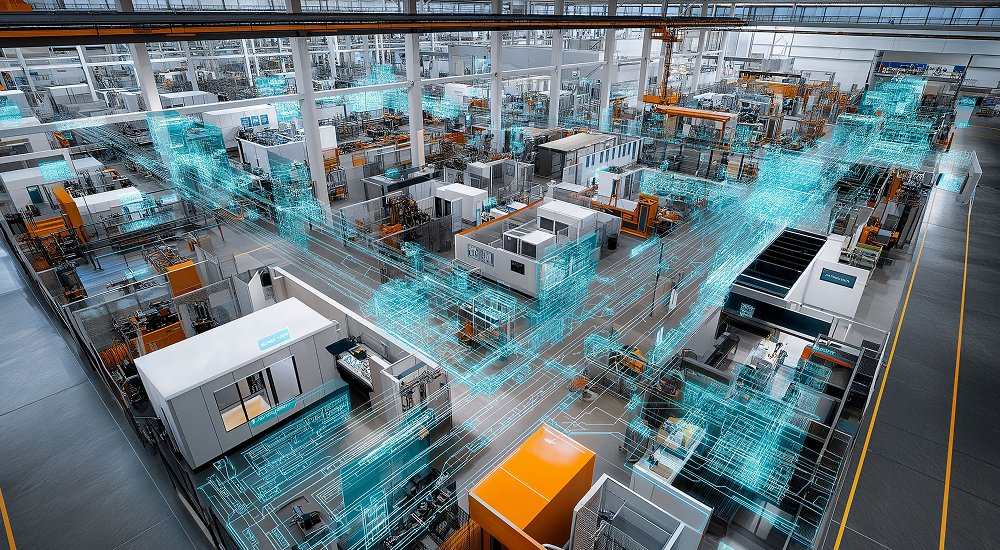
That distinction matters in semiconductor manufacturing. A modern fab is an interconnected system, not just a set of isolated tools and recipes. Thousands of lots move across hundreds of process flows, interacting with hundreds of tools, and continuously generate large volumes of data. A maintenance event, process deviation, or scheduling change in one area can ripple through the factory, affecting output, cycle time, and delivery performance.
And yet, most fabs still manage that complexity reactively. Teams gather data from multiple systems, meet to compare findings, and work through the implications together. That process is necessary, but it is also slow. By the time the team has assembled, the problem is already growing. And by the time the issue is understood, yield or cycle time impacts are already spreading.
That is why digital twins are drawing so much attention. There is an opportunity to move toward a system-level representation of the fab that helps teams spot interactions earlier, evaluate trade-offs faster, and act before variability turns into missed targets.
Why do data-rich factories make slow decisions?
Semiconductor fabs generate plenty of data, but that doesn’t always translate into clarity. Process, equipment, production, and planning teams each rely on their own dashboards and monitoring tools. The lack of shared content across factory domains slows decision making. And while dashboards are important, they rarely explain why something is happening across the broader factory.
This is where a digital twin becomes valuable; an integrated view of data from across the factory helps teams make faster, more confident decisions that protect yield, stabilize cycle time, and keep local issues from becoming factory-level problems.
A digital twin changes the question
At its core, a digital twin shifts the conversation from fragmented visibility to system-level understanding. Instead of navigating disconnected dashboards and siloed metrics, teams work from a unified view of the factory and explore data in context.
That changes the questions teams can ask. Instead of asking why one dashboard turned red, they can ask what changed across the system, what is likely to happen next, and which action is most likely to improve the outcome.
As these capabilities mature, that unified view should make it easier to connect factory-level conditions to the process, equipment, or scheduling events behind them. Generative AI adds another layer by letting users ask specific questions across complex, multi-source factory data. That does not replace engineering judgment, but it can accelerate insight when timing and context determine whether an issue remains manageable or turns into a KPI problem.
Closing the gap between observation and action
The next step in this evolution is moving from observation to prediction, recommendation, and action.
Many factories are good at explaining what happened yesterday. The larger opportunity is to see where performance is heading while there is still time to influence it. An AI-enabled digital twin becomes key here because it can improve both the quality and the timing of decisions.
Consider a common fab scenario: a critical tool or subsystem is nearing a lengthy maintenance event. Today, managing that event often requires several teams to coordinate capacity, scheduling, and downstream risk. The decision affects line balance, hot lots, delivery commitments, and utilization of other tools.
In a more mature digital twin environment, that same event could be handled more effectively. Maintenance actions could update capacity models. Simulations could evaluate trade-offs and recommend response options. Risks to cycle time, output, or delivery could be raised earlier, before the impact spreads through the fab. The benefit is clear: enabling faster actions leads to better manufacturing outcomes.
Better timing is the real competitive advantage
The value of faster decisions comes down to timing. A proactive corrective action can have a very different economic impact than the same action taken after WIP has built up or ship dates have slipped.
If digital twins evolve as many manufacturers expect, operations could shift from meeting-driven coordination to a more continuous, data-guided response. People still make the decisions, but with earlier warning, better context, and a clearer sense of which actions are most likely to protect factory performance.
Parts of that vision already exist in targeted use cases. AI is being applied to scheduling, process control, fault detection, and predictive maintenance. Simulation tools already help manufacturers evaluate selected future-state scenarios. The broader vision is connecting those capabilities into a more coordinated decision-support layer for the entire factory.
Building the foundation for AI-driven decisions
Delivering that vision requires real-time data integration across traditional manufacturing software systems, AI models that can interpret the data, and simulation capabilities that can test what-if scenarios quickly enough to support operations.
In practice, that means bringing together data from MES, material control, production scheduling, equipment automation, process control, and other factory domains into one unified environment. It also means solving basic problems of data quality, timing, and context so models can support real decisions.
Many of the technical building blocks are emerging, but making them work together in a way that improves factory-level performance is a work in progress.
Decision speed drives business value
The business implications are substantial:
- Earlier identification of process issues could help reduce scrap.
- Better coordination around maintenance and capacity could improve utilization.
- More system-level understanding could support lower cycle time, better delivery performance, and improved cost per wafer.
Even small improvements in those metrics can have a meaningful financial impact in high-volume manufacturing. Manufacturers that make better, faster decisions are more equipped to respond to variability, recover from disruption, and operate with greater resilience under pressure.
Where the industry stands today and what’s next
It is important to be clear about where the industry stands today. Fully integrated, AI-enabled digital twins that coordinate real-time data, predictive models, and system-wide recommendations across the factory are still emerging. Today’s reality is closer to a set of advancing capabilities than a finished end state.
That does not weaken the direction of travel. It makes the challenge clearer. The industry is moving from isolated optimization toward broader, connected decision support. Manufacturers that connect these pieces effectively will be better positioned to improve outcomes as manufacturing and business complexity continue to rise.
The future of semiconductor manufacturing won’t be defined simply by more data and more dashboards. It will be defined by how effectively manufacturers can turn data into insight and insight into timely action. That is the promise of AI-enabled digital twins: better timing, better decisions, and better factory performance.