
What’s Inside
- End-to-End Quality requires more than better inspection
- Quality starts before the fab
- The missing link: Integration and contextualization
- Why late detection is built into the process
- From reactive guardrails to learning systems
- AI needs better inputs, not just better algorithms
- Full automation raises the stakes
- The path forward: detection, prediction, prevention
- Conclusion
End-to-End Quality requires more than better inspection
In semiconductor manufacturing, quality issues rarely begin where they are detected. A nonconformance may surface during metrology, inspection, yield analysis, or even after a customer return—but its root cause can originate much earlier: in product design, supplier manufacturing, inbound logistics, storage conditions, material handling, equipment configuration, or the way consumables and durables are introduced into production.
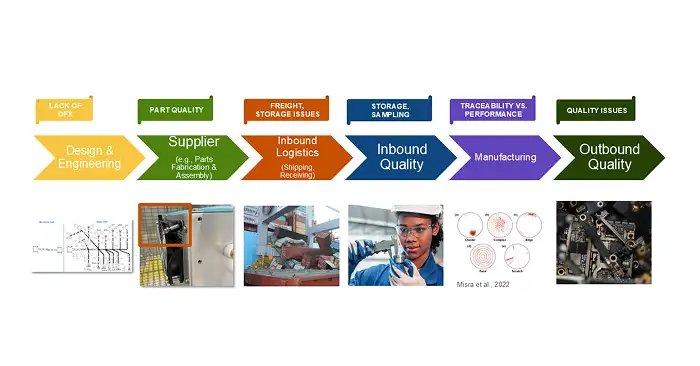
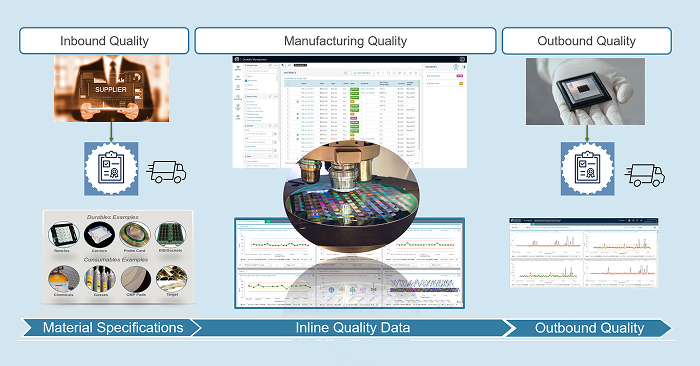
That is why end-to-end quality is becoming one of the most important conversations in advanced manufacturing. The industry has made enormous progress in equipment health monitoring, SPC, metrology, chamber matching, tool matching, and process control. Yet, many manufacturers still lack a fully connected view of quality from supplier to finished product. The result is a persistent gap between incoming quality, manufacturing quality, and outbound customer quality
(See Figure 1).
Quality starts before the fab
Manufacturing quality does not begin at the first process step. It starts with the specifications used to design and purchase materials, parts, chemicals, consumables, durables, and subassemblies. It continues through supplier manufacturing, certificates of conformance, freight conditions, receiving, sampling, storage, and ultimately the movement of materials into production.
Each point in that chain can introduce risk. Materials may meet its specifications at the supplier but be compromised during transit. A chemical may arrive with documentation but experience temperature excursions before use. A consumable may pass incoming quality sampling yet age out or degrade in storage. A gas bottle may feed multiple tools, making the source of a downstream issue difficult to isolate. By the time a defect is detected, the affected lots may already have moved far beyond the original point of failure.
The missing link: Integration and contextualization
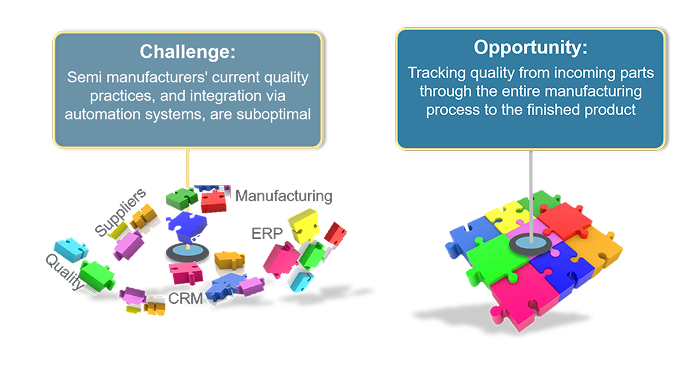
Most fabs have strong quality systems—but those systems were often designed around specific functions. Incoming quality teams work with suppliers and certificates of conformance (CoC). Manufacturing teams focus on equipment, processes, lot movement, and yield. Outbound quality teams manage customer returns, 8D investigations, and field issues. Each organization may have effective tools, but the data is often fragmented across systems and business processes.
The challenge, as shown in Figure 2, is not simply connecting systems through an interface. The real challenge is preserving context: what material was purchased, who supplied it, how it was manufactured, how it was transported, where it was stored, when it was moved into production, which tools it touched, which lots were exposed, and what quality outcomes followed. Without that context, quality teams may know that a problem occurred but lack the visibility needed to understand why.
Why late detection is built into the process
From reactive guardrails to learning systems
Traditional quality systems are often interrupt-driven. If a value exceeds a limit, a rule triggers. If a trend violates a control rule, the process stops. These guardrails are essential, but they primarily focus on what went wrong. They do not always capture what went right—or explain why certain combinations of supplier, material, equipment, process, and handling conditions consistently produce better outcomes.
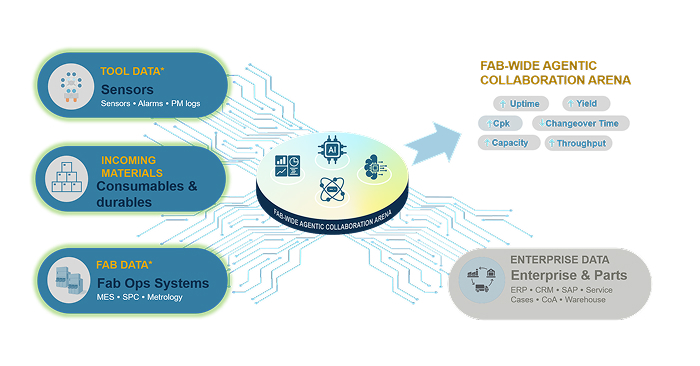
This is where AI and agentic systems can change the quality paradigm. When granular, contextualized data is available, AI can help manufacturers move from reactive detection toward prediction, prevention, and continuous learning (see Figure 3). It can help identify hidden commonalities across lots, tools, materials, suppliers, and process windows. It can also help preserve institutional knowledge and uncover patterns that experienced engineers may not have had the full data context to see.
AI needs better inputs, not just better algorithms
AI can only be as effective as the information it can access. If supplier, material, and handling data are excluded from the quality model, the system has blind spots. If data is too coarse, disconnected, or missing context, AI may produce incomplete or misleading conclusions. Reliable AI for end-to-end quality, therefore, depends on three foundational capabilities: granular traceability, integrated data flows, and contextualized relationships across business and manufacturing systems.
For example, detecting that three tools experienced related quality excursions may not be enough. The key question is whether those tools shared a common consumable, gas source, supplier lot, maintenance event, or environmental exposure. Without contextualization, each excursion may look isolated. With contextualization, the common root cause becomes discoverable.
Full automation raises the stakes
It is tempting to assume that fully automated fabs are less exposed to nonconformance risk than semi-automated or manual environments. In reality, automation can amplify both good and bad outcomes. If an error is introduced into a process flow, recipe, material handling step, or configuration, automation can repeat that error rapidly and consistently across many lots before detection.
This makes end-to-end quality even more critical in highly automated environments (see Figure 4). The faster a fab moves, the more important it becomes to identify abnormal patterns early, trace affected material quickly and understand common causes before quality issues scale into yield loss or customer impact.
The path forward: detection, prediction, prevention
The evolution of AI-enabled quality will likely follow a crawl-walk-run path. The first step is detection: helping engineers ask better “why” questions of their data and accelerate investigations. The next step is prediction: identifying risks earlier, such as lot yield, defect trends, cycle time, or shipment risk. The longer-term opportunity is prevention: creating agentic systems that monitor, reason, recommend, and eventually orchestrate actions across supplier, fab, equipment, process, and quality systems.
That future will not be built by AI alone. It will require manufacturing systems that expose the right data, business processes that capture the right events, and quality frameworks that connect the full product lifecycle from supplier to customer. AI becomes powerful when it is grounded in accurate, granular, and contextualized manufacturing truth.
Conclusion
End-to-end quality is not just a supplier quality problem, a manufacturing problem, or a customer quality problem. It is a systems problem. The next generation of quality performance will come from connecting the dots across the entire lifecycle: design, sourcing, supplier manufacturing, logistics, receiving, storage, production, test, yield, and field performance.
Manufacturers that invest in integration, contextualization, and AI-ready traceability will be better positioned to detect issues earlier, reduce excursion scope, accelerate root cause analysis, improve yield, and build learning systems that get smarter over time. In an industry where complexity continues to rise, the ability to see quality from end-to-end may become one of the most important competitive advantages.
If you’re ready to rethink how your fab handles End-to-End Quality, reach out.
FAQs
Why do quality problems often show up long after the actual issue occurred?
In semiconductor manufacturing, the event that reveals a problem is often not the event that caused it. A defect may become visible during inspection, testing, or yield analysis even though the contributing condition occurred much earlier in the product lifecycle. Without complete traceability across materials, suppliers, logistics, storage, equipment, and production processes, teams can struggle to identify where the issue originated and which products may have been affected.
How can manufacturers find the root cause of recurring quality excursions faster?
Faster root-cause analysis depends on connecting information that is typically stored in separate systems. When quality, manufacturing, equipment, supplier, and material data can be analyzed together, engineers gain the context needed to uncover relationships that would otherwise remain hidden. This helps determine whether multiple events share a common source and reduces the time spent investigating isolated symptoms.