What’s Inside
- The scale of the challenge
- Regulatory reckoning
- Customer pressure: Scope 3 comes home
- The three pillars of fab energy management
- Use case: smart sleep for equipment and sub-fab systems
- Use case: energy-aware scheduling
- Use case: simulation for energy analysis
- The integration imperative
- The investment case
- What are leading fabs doing?
- The path forward
- Energy as competitive advantage
Semiconductor manufacturing has always been energy intensive. Advanced fabs consume 100–200 megawatts continuously, making energy one of the largest operational inputs. But what was once a manageable cost is now a strategic constraint.
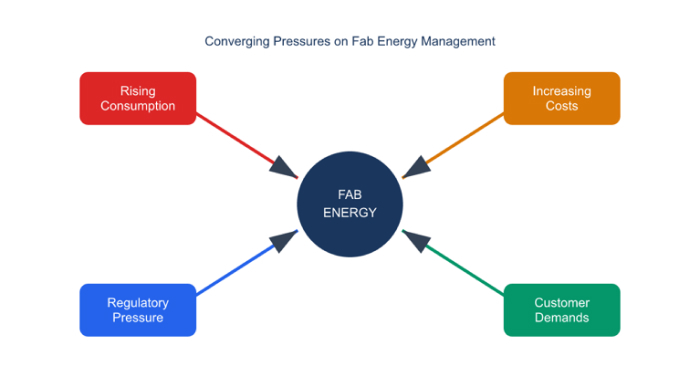
Energy prices are rising, regulatory requirements are tightening, and customers are demanding carbon transparency across the supply chain (see Figure 1). Meanwhile, the push to advanced nodes and higher volumes is increasing energy demand faster than efficiency gains can offset. Energy has moved from an operational cost to a core competitive factor. Fabs that address this challenge can strengthen margins, reduce regulatory risk, and improve customer alignment. Those that do not will face increasing exposure to cost pressure, compliance disruption, and customer attrition.
The scale of the challenge
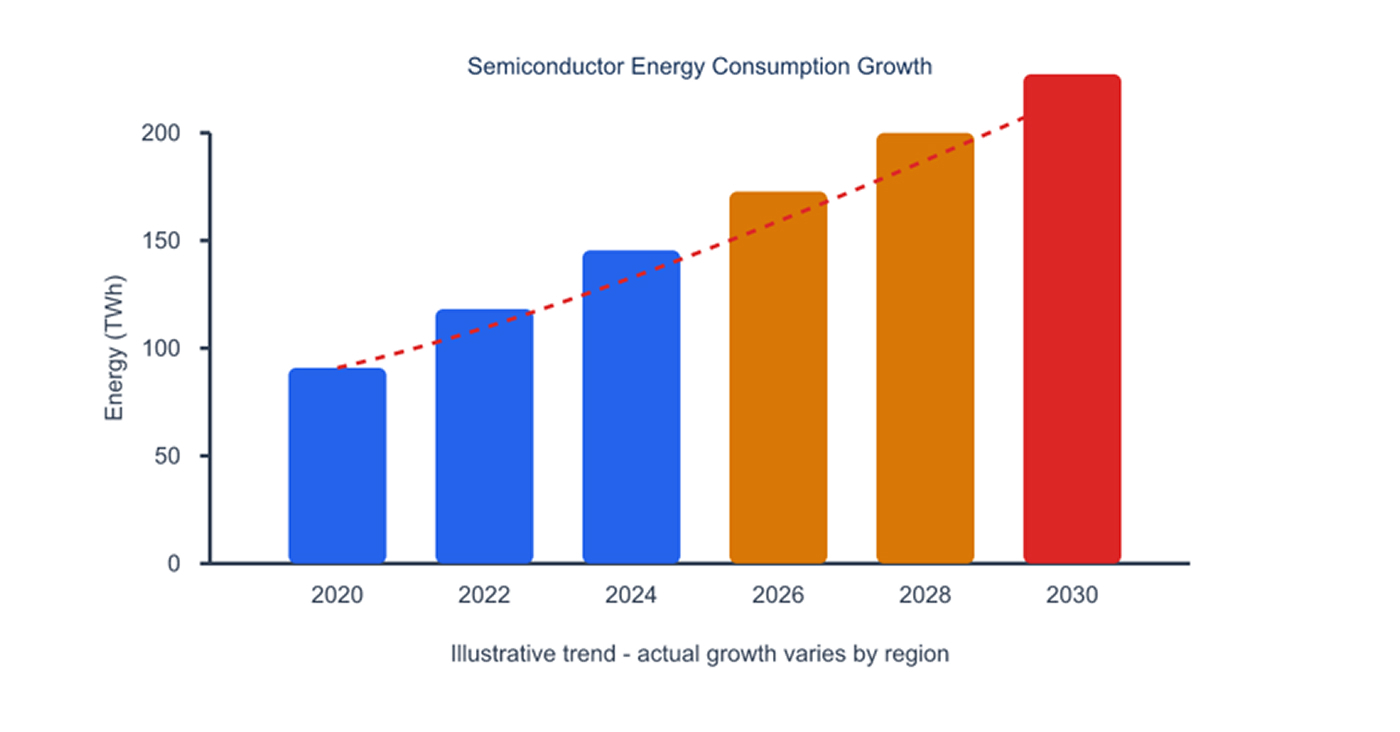
The magnitude of semiconductor energy consumption is significant and growing rapidly, as shown in Figure 2. Leading manufacturers consume tens of terawatt hours annually, and advanced nodes continue to drive higher energy intensity per wafer. Technologies such as EUV lithography add substantial, continuous power requirements at the tool level.
Across the industry, energy demand is expected to increase through the remainder of the decade, driven by capacity expansion and accelerating demand for AI and high-performance computing. This growth has direct financial implications because energy now represents a meaningful and rising portion of fab operating expenses. At the same time, power availability itself is becoming a constraint. Key regions such as Taiwan, Arizona, and Texas are experiencing grid pressure as fabs compete with data centers, electric vehicle production, and residential demand. Renewable energy adoption is critical, but it is not sufficient on its own to address these structural limitations.
Regulatory reckoning
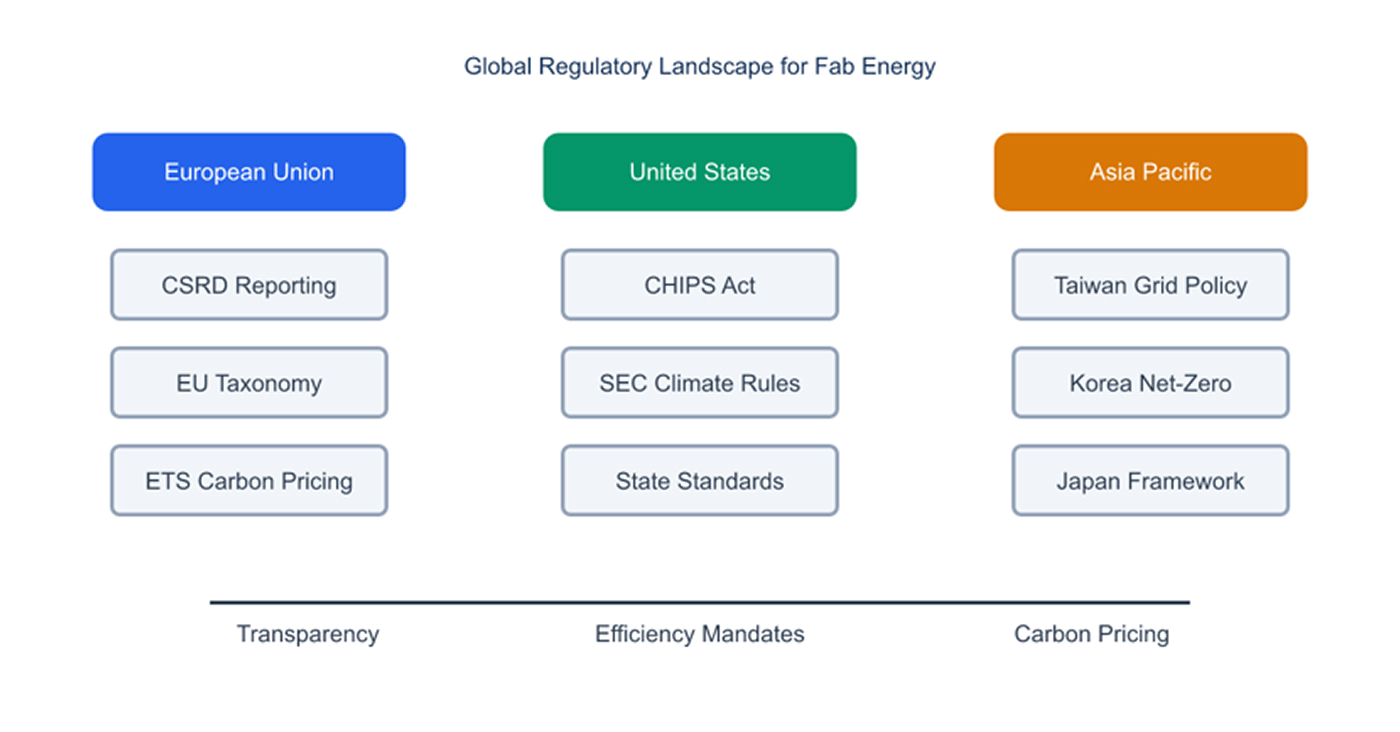
Regulatory requirements are also quickly evolving. Manufacturers increasingly must disclose energy and emissions data, report Scope 1, 2, and increasingly Scope 3 emissions, and meet efficiency requirements tied to incentives, financing, and reporting frameworks (see Figure 3).
The trajectory is clear: transparency today, efficiency mandates in the near term, and broader carbon pricing over time. Having energy management capabilities in place will help fabs avoid future compliance costs and operational disruption.
Customer pressure: Scope 3 comes home
The three pillars of fab energy management
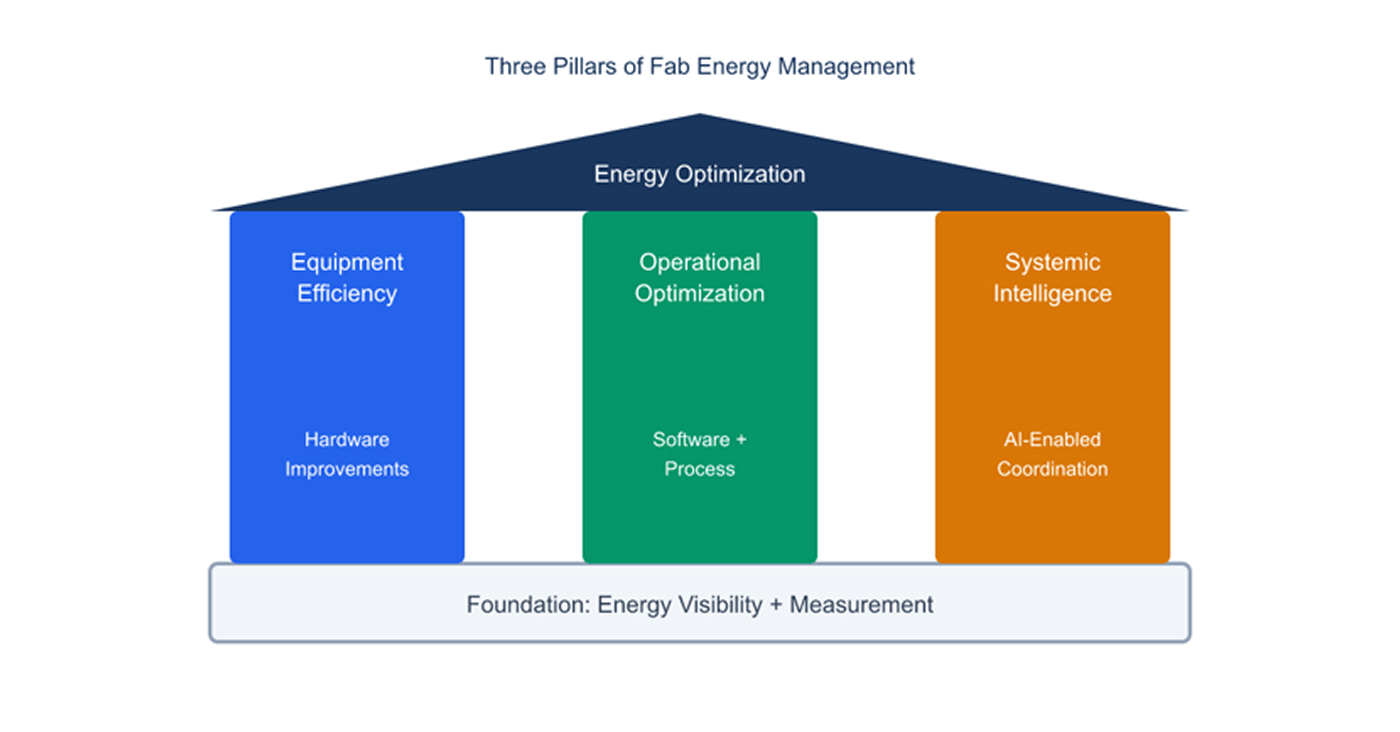
Addressing energy consumption in semiconductor manufacturing requires a multi-layered approach built on three foundational pillars: equipment efficiency, operational optimization, and systemic intelligence (see Figure 4).
Equipment efficiency focuses on hardware-level improvements such as better components, integrated peripheral devices, and heat recovery systems. Operational optimization extracts more performance from existing assets through intelligent scheduling and predictive maintenance, and systemic intelligence integrates production systems, sub-fab infrastructure, and real-time energy data into a coordinated framework for real-time optimization.
While all three pillars are important, long-term advantages will come from systemic intelligence. Energy must be treated as a managed resource across the entire manufacturing system—not just at the tool level.
Use case: smart sleep for equipment and sub-fab systems
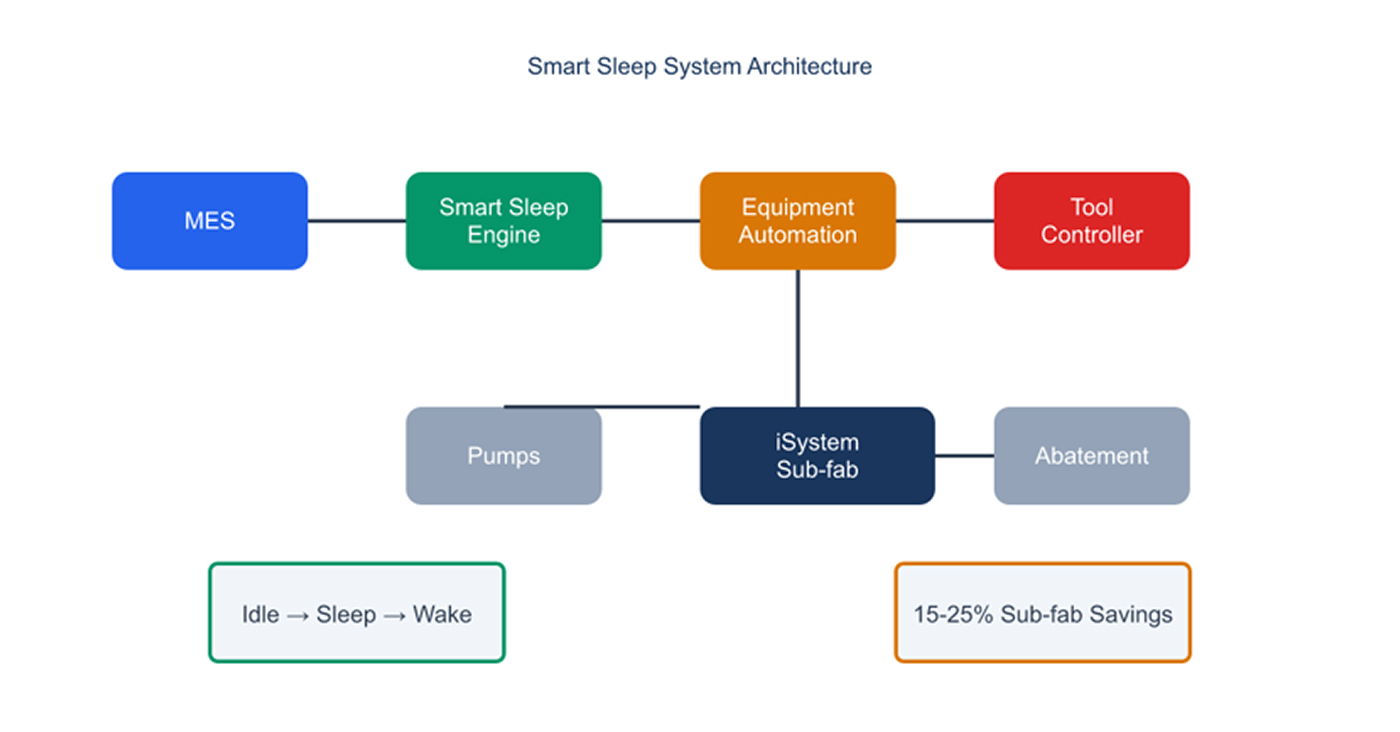
The simplest energy-saving intervention is turning things off when they are not needed. But in a fab, “off” is complicated. Equipment cannot instantly switch from idle to production-ready and wake-up times range from seconds to more than 30 minutes, depending on the system. Additionally, sub-fab equipment—pumps, abatement systems, cooling—must coordinate with process tools. Turning something off at the wrong time risks yield excursions or safety events.
Smart sleep systems address this challenge by predicting idle time and transitioning equipment into lower-energy states when conditions allow. By integrating with MES data, they can anticipate production needs and ensure tools return to readiness in time to meet demand. Sleep modes can include pump speed reduction, N2 flow reduction, heater temperature setback, and other energy-saving configurations.
The energy savings are meaningful. Sub-fab equipment alone can represent 30–40% of fab energy consumption. Transitioning from always-on operation to intelligent sleep modes can reduce sub-fab energy by 15–25% without impacting production availability (see Figure 5).
Use case: energy-aware scheduling
Traditional scheduling systems optimize for productivity metrics such as cycle time and throughput. Energy consumption is typically treated as a fixed cost rather than a variable that can be optimized.
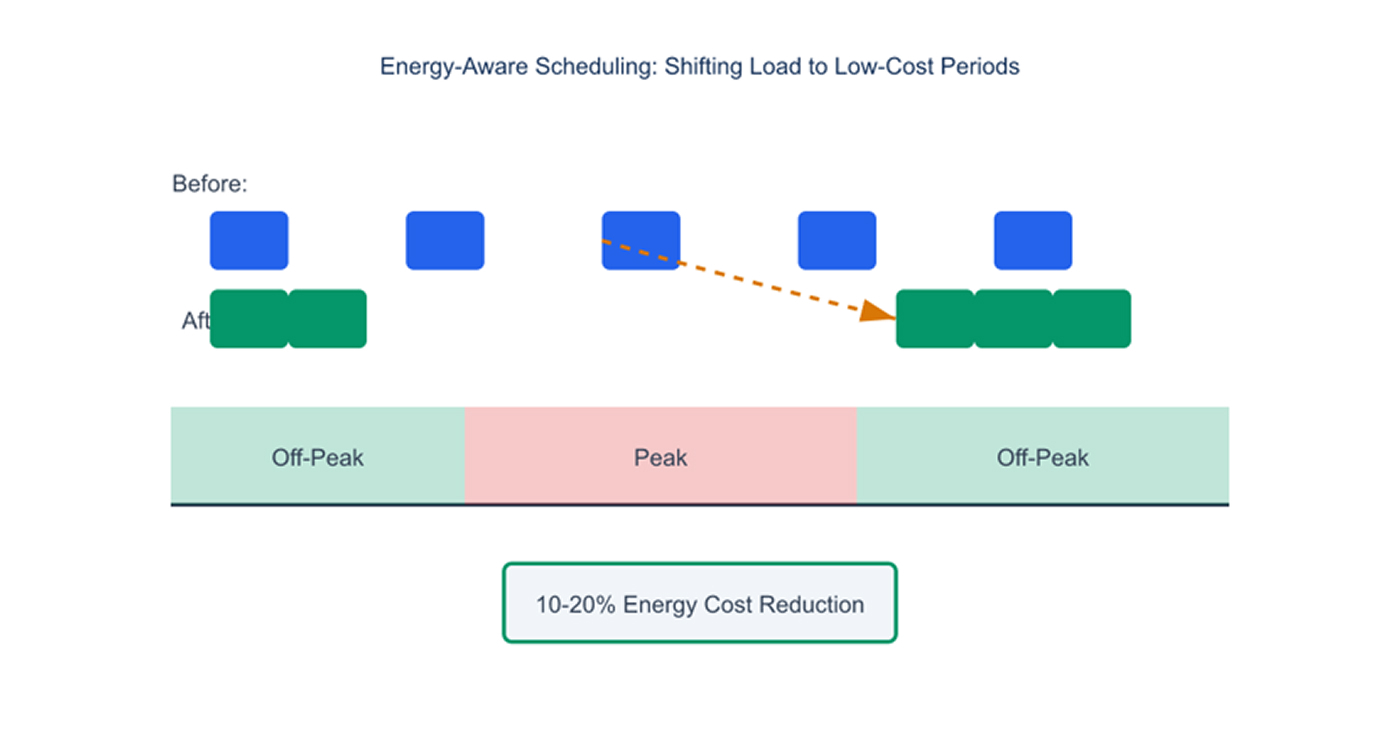
Energy-aware scheduling introduces energy as a secondary objective without compromising primary goals. By incorporating consumption profiles, equipment efficiency, and time-of-use pricing, scheduling decisions can reduce energy costs while maintaining performance targets. Implementation requires granular energy modeling, rate-structure integration, and multi-objective optimization that balances productivity and energy objectives.
Even modest adjustments such as shifting high-energy processes to off-peak periods or selecting more efficient equipment can yield meaningful savings. Early implementations show potential for a 10–20% reduction in energy costs without measurable productivity impact, as shown in Figure 6. As a software solution, energy-aware scheduling does not require equipment modifications or capital investment; it extracts value from existing infrastructure through smarter decisions.
Use case: simulation for energy analysis
You cannot optimize what you cannot measure. In many fabs, energy data is still aggregated at a high level, limiting the ability to understand and optimize consumption at a granular level.
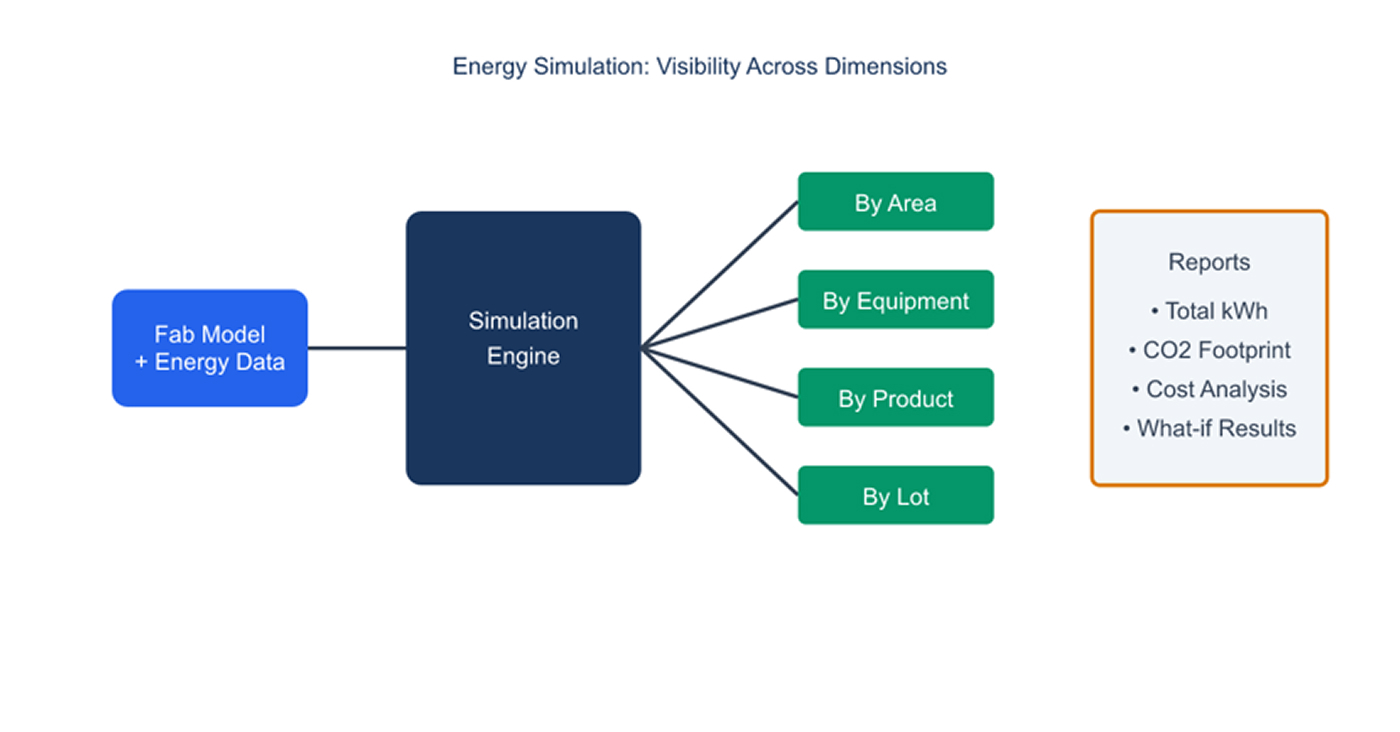
As depicted in Figure 7, below, energy simulation extends existing fab models to include detailed energy profiles across process equipment, sub-fab systems, and facility infrastructure. Energy outputs can be viewed alongside productivity metrics and carbon footprint estimates based on grid emission factors.
The real value lies in predictive analysis. Simulation enables teams to evaluate the energy impact of changes in product mix, capacity, scheduling strategies, or equipment configuration before implementing them. It also supports compliance reporting by providing the data needed for emissions tracking and customer disclosures. This capability transforms energy from an unpredictable externality into a manageable variable for Operations, Finance, and Sustainability teams.
The integration imperative
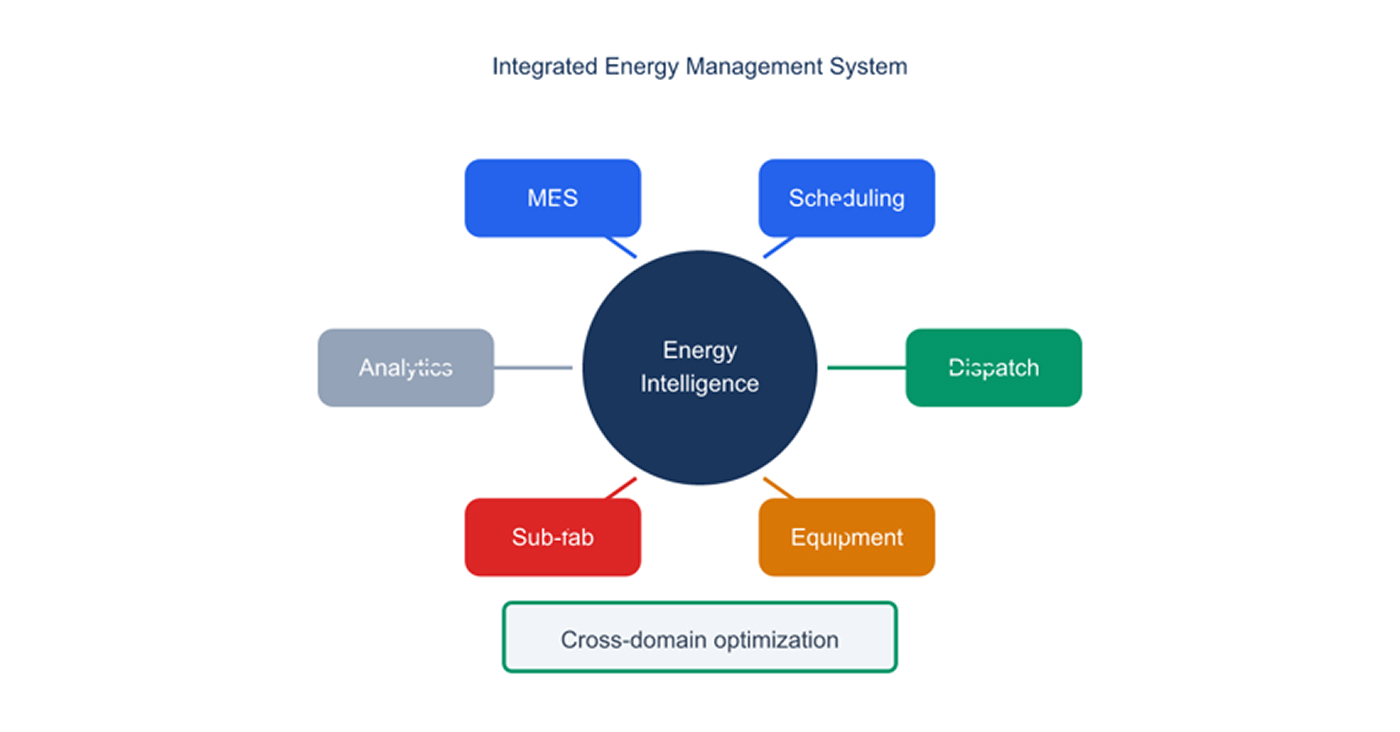
While each approach delivers value independently, the greatest impact comes from integration like that seen in Figure 8. Coordinating scheduling with smart sleep strategies can create longer idle windows and unlock deeper savings. Integrating energy data with maintenance systems can identify inefficiencies before failure, while real-time pricing data can inform dispatching without disrupting production.
These cross-domain optimizations require connected systems and shared data models. As complexity increases, AI-enabled decision-making becomes critical. Intelligent systems can continuously evaluate trade-offs between productivity and energy objectives in ways that isolated tools or manual processes cannot.
The investment case
Energy management investments compete with other capital priorities, so the case must be made in financial terms. The business value extends beyond direct savings: lower operating costs, avoided demand charges, stronger regulatory readiness, better customer alignment, and reduced exposure to energy-price volatility and grid constraints.
As supply-chain decarbonization accelerates, customer retention and acquisition may become the strategic prize. Fabs that can demonstrate low-carbon manufacturing will be better positioned to win preferred supplier status, and that value can exceed direct energy savings. The investment case varies by fab, region, and market position, but the trajectory is consistent: energy management capabilities are becoming more valuable over time, not less.
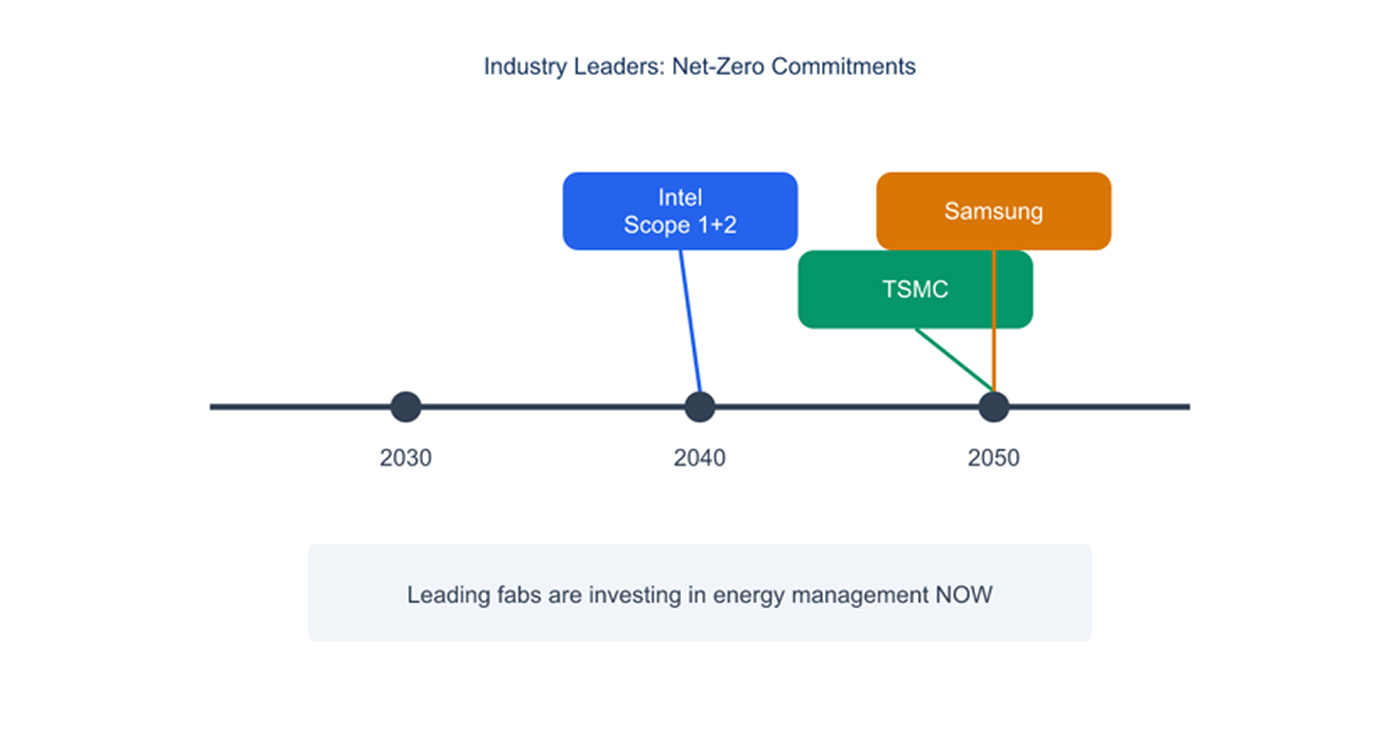
What are leading fabs doing?
The path forward
Energy management maturity typically evolves through four stages: visibility, efficiency, optimization, and intelligence. Most fabs today are still building foundational visibility and implementing targeted efficiency improvements. Forward-looking organizations are moving toward integrated optimization and AI-driven systems.
This progression is not optional. Market dynamics, regulatory pressure, and customer expectations will continue to push the industry forward. The only question is how quickly each organization adapts.
Energy as competitive advantage
The semiconductor industry’s relationship with energy is changing. What was once a background cost is now a strategic variable.
Fabs that invest in energy management will benefit from lower costs, stronger customer alignment, improved compliance, and greater operational resilience. Those that do not will face increasing constraints and competitive disadvantage. Energy management is not a distraction from fab competitiveness; it is fab competitiveness.
Applied Materials APG is developing comprehensive energy management solutions for semiconductor manufacturing—from smart sleep systems to energy-aware scheduling, to simulation-based analysis. Learn how we’re helping fabs reduce energy consumption while maintaining productivity.