Traditional Assembly, Test and Packaging has reached an inflection point
Traditional Assembly, Test and Packaging (ATP) has long been viewed as the labor-intensive, less complex end of semiconductor manufacturing — a place where capacity could be added by adding operators and shifts. That assumption no longer holds.
Automotive qualification requirements, industrial and memory product mixes, and the arrival of AI-driven device architectures have pushed operational complexity in back-end factories to levels that increasingly resemble a wafer fab. Lot sizes are smaller, product mixes are wider, traceability requirements are deeper, and schedule changes arrive weekly rather than quarterly. Under those conditions, adding headcount adds variability faster than it adds output.
Four forces accelerating the move to Full Auto
Several shifts are now pushing ATP manufacturers toward a more automated operating model. Together, these forces are making Full Auto less of a future-state goal and more of an immediate competitive requirement.
Workforce economics: Labor availability is tightening across every major ATP region while labor cost rises. Retention and training cycles make tribal knowledge fragile, and multi-site manufacturers struggle to run the same operation the same way in two different countries.
Manufacturing complexity: Mixed product flows, more process variations, tighter compliance expectations, and unit-level genealogy have outgrown spreadsheet-based coordination.
Customer expectations: Shorter delivery commitments, faster response to engineering changes and greater schedule flexibility have made responsiveness a competitive criterion, not a service extra.
Digital transformation mandates: Smart Manufacturing, Industry 4.0 and AI programs all depend on the same prerequisite: clean, real-time, factory-wide data and the ability to act on it automatically.
The challenge is no longer producing more units; it’s producing the right units, at the right time, at the lowest cost per unit — consistently, across every shift and every site.
What “Full Auto” actually means
The most common misconception is that Full Auto means robots, AGVs or an AMHS install. Automated material movement is one layer of it, and on its own it rarely delivers the business case. SmartFactory describes back-end automation as a four-stage progression, as shown in Figure 1.
The ATP automation maturity ladder
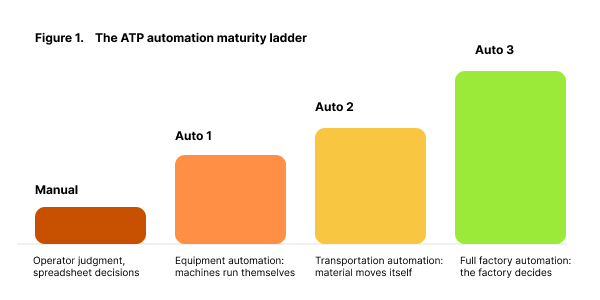
The fourth and final stage, Auto 3, is where the economics change. Here, the factory is not only executing without manual touchpoints, it is deciding without them. It is choosing the next lot, reserving the right resources, reacting to a down tool and re-sequencing the line, all while holding to the business rules the factory was given.
Full Auto is a platform, not a project
Many Full Auto initiatives stall because they are scoped as a single system implementation. In practice, no single application can own production execution, equipment integration, material movement, dispatch logic, exception handling and scheduling at once. Those capabilities have to operate as one coordinated platform (see Figure 2).
The four connected layers of a Full Auto ATP factory
Execution and decision layers have to close the loop; either one alone plateaus.
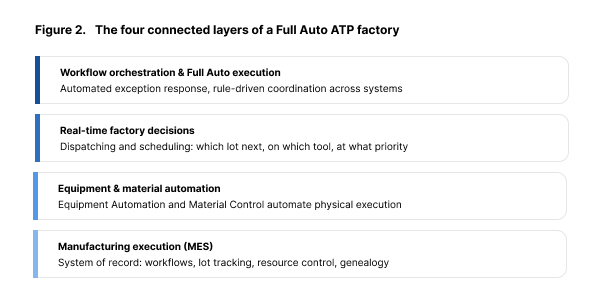
The MES is the system of record for workflows, lot tracking, resource control and traceability. Equipment Automation and the Material Control System automate physical execution. Real-Time Dispatching turns a reactive floor into one that continuously decides which lot runs next, on which tool, and how priorities and constraints are balanced. And because exceptions are inevitable — a tool goes down, material is constrained, a hot lot arrives — workflow orchestration coordinates the response across every system automatically, without waiting for a supervisor.
Historically, ATP manufacturers ran these as separate efforts: an MES project, an AMHS project, an equipment integration project, and a scheduling project. Each delivered value, and each became a silo. The next generation of competitiveness comes from connecting them into one operational framework where data, decisions, and execution move seamlessly across the factory.
What the results look like
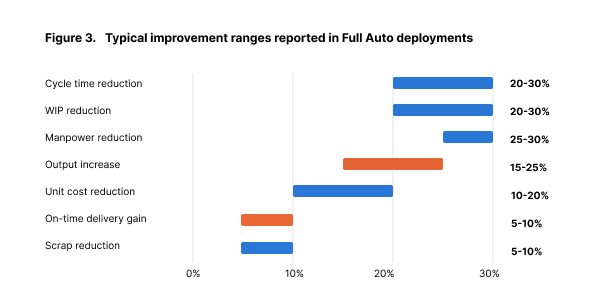
Just as important, the gains are repeatable. Once decision logic lives in the platform rather than in the heads of the most experienced supervisors, a second or third site can be brought to the same performance level without rebuilding the operating model from scratch.
From Full Auto to autonomous manufacturing
The next step is not more automation — it is autonomy. AI scheduling engines, reinforcement learning optimization, digital twins that validate a decision before the factory executes it, and agentic AI that surfaces problems before anyone asks are all moving from roadmap to production. Each adds incremental gain on top of a well-run dispatching baseline, and each depends on the same foundation: automated execution and clean, real-time factory data.
The trajectory is consistent across the industry: manual, automated, intelligent, and on to autonomous. A factory that has not completed the automated step cannot begin the intelligent one.
Conclusion
Traditional ATP manufacturing is entering a new era. Automation has stopped being a technology initiative and become a business imperative. As product complexity rises, labor availability tightens and customers expect faster commitments. Full Auto is becoming the foundation of competitiveness rather than a differentiator at the margin.
The manufacturers that combine execution automation, intelligent decision systems and AI-driven optimization will deliver higher productivity, better quality and greater operational agility, while their competitors are still recruiting operators.