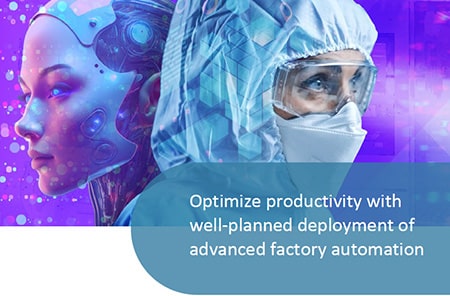

Every semiconductor fab today runs on a carefully assembled stack of productivity tools (see Figure 1). Reporting dashboards track WIP and cycle time. Dispatching systems decide what runs next. Scheduling engines allocate lots to equipment. Capacity planning models forecast throughput weeks and months ahead.
Each system does its job, but none of them talk to each other.
What is the impact of institutional knowledge on semiconductor fabs?
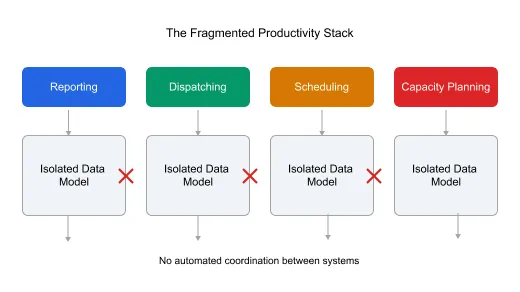
Walk into any fab control room and you’ll find the real integration layer is industrial engineers. As shown in Figure 2, IEs are the human glue connecting disconnected systems. They monitor reporting dashboards, interpret anomalies, translate insights into scheduling adjustments, update dispatch rules, and reconcile execution reality with capacity plans.
This works—until it doesn’t.
The average semiconductor IE has 15-20 years of experience. They carry institutional knowledge that exists nowhere in documentation: which tools run hot on certain products, which dispatch rules to override during high-mix periods, which scheduling constraints are hard limits versus soft guidelines. When an IE looks at a report and immediately knows something is wrong, they’re drawing on pattern recognition built over decades.
The industry is losing this expertise faster than it can be replaced. Industry analysts estimate that a significant portion of the semiconductor workforce—potentially 20-30%—will reach retirement age by the end of this decade. The tribal knowledge walking out the door isn’t captured in any system.
Meanwhile, the systems themselves keep multiplying. Fabs have invested heavily in best-of-breed tools, each of which is optimized for its domain, has its own data model, and requires manual intervention to coordinate with the others.
As a result, the productivity stack looks impressive on paper but creates constant friction in practice.
The 3:00 AM escalation
Consider a scenario that plays out in fabs every week:
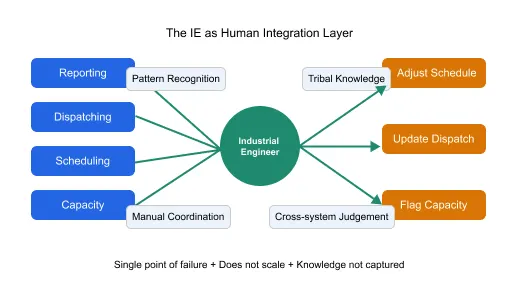
It’s 2:47 AM. A critical etch tool starts showing intermittent faults. The equipment monitoring system logs the anomaly. The reporting dashboard updates to show the tool is running at 60% efficiency.
The scheduling system doesn’t know. It still has 47 lots queued for that tool over the next shift, so the dispatch system keeps sending WIP toward the bottleneck.
Forty-five minutes pass before the severity triggers an automated page to the on-call IE. She logs in remotely, sees the situation, and starts the manual rebalancing process: hold lots upstream, redirect WIP to alternate tools, adjust the schedule, notify the next shift.
By the time equilibrium is restored, three hours have passed. As shown in Figure 3, the cycle time impact is 12-18 hours on affected lots. If this happens twice a month, which is not unusual for a fab running 500 or more tools, the annualized cycle time loss is measured in days.
This isn’t a tool failure; every system worked exactly as designed. The failure is in the gaps between systems that only human intervention can bridge.
Capacity planning disconnect
Next, consider a different scenario that is slower burning but equally costly:
- The monthly capacity plan shows comfortable headroom.
- Demand is forecasted at 95% of theoretical capacity.
- Utilization targets look achievable. Leadership signs off.
Three weeks later, the fab is in crisis, WIP is pooling at specific tool groups, cycle times are blowing past commitments, and expedited lots are trampling the schedule. What happened?
The capacity plan assumed average product mix, but reality delivered a mix skewed toward products with longer process times on constrained tools. The plan assumed historical equipment availability and reality delivered a cluster of preventive maintenance windows that weren’t reflected in the model. And, the plan optimized for throughput whereas reality required yield-driven reruns that consumed capacity the model didn’t anticipate.
None of this was invisible. The reporting system showed the divergence building day by day, but there was no feedback loop—no mechanism for execution reality to update planning assumptions automatically. By the time the monthly plan review surfaced the gap, three weeks of suboptimal decisions had compounded.
Capacity planning accuracy in high-mix fabs varies widely, but many operations teams report meaningful gaps between plan and execution. That gap isn’t purely model error; it’s the gap between planning assumptions and execution reality, multiplied by the absence of closed-loop feedback.
Tribal knowledge trap
There is also a third, and perhaps the most insidious, scenario in which a fab runs a high-value product—call it Product X—on a specific tool group. The standard dispatch rules say to maximize batch sizes for throughput, but one senior IE always intervenes when Product X runs during high-mix periods. He reduces batch sizes, accepting lower throughput on that tool to prevent WIP starvation downstream.
He has never documented this because, to him, it’s obvious. He can see the downstream queue depths and knows from experience what happens when Product X lots arrive in large batches. He’s been doing it for 12 years.
Then he retires.
His replacement follows the standard rules and, three weeks later, a downstream bottleneck that hasn’t occurred in years resurfaces. It takes six months of investigation to connect the cause to dispatch behavior on Product X. The knowledge gap costs 4% cycle time during that period, totaling millions in delayed revenue.
This scenario plays out in every fab:
- A specific override prevents yield excursions.
- A scheduling tweak accommodates an undocumented equipment constraint.
- The reporting threshold triggers early intervention.
Tribal knowledge accumulates because systems don’t capture the reasoning behind human decisions—only the decisions themselves.
The scaling bottleneck
These three scenarios share a common root in that the IE is the integration layer and human integration doesn’t scale.
An experienced IE can monitor one sector of a fab effectively. For her area, she can hold the mental model of WIP positions, tool states, schedule commitments, and capacity constraints in her head. Ask her to cover two sectors and quality degrades, three sectors and she’s firefighting instead of optimizing.
Fabs respond by adding headcount but the expertise pipeline is constrained, the training period is long, and the retirement wave continues. The math doesn’t work; you can’t hire your way out of an integration problem.
The alternative is tighter system integration, which has been the dream for 20 years; MES vendors promised it and platform consolidation initiatives pursued it. However, the reality is that most fabs still run 5-10 major systems that share data through batch exports, manual entry, or middleware that requires constant care and feeding.
Integration projects fail for predictable reasons. Systems have different data models, vendors have different incentives and interfaces calcify as soon as they’re built. The cost of true integration exceeds the budget for any single project, so it never happens.
What is the cost of fragmentation of fab productivity systems?
Quantifying the cost of disconnected systems is difficult because it’s distributed across many small inefficiencies rather than one visible failure.
But the directional math is clear:
- Decision latency: Minutes to hours lost waiting for human translation between systems. Anecdotal evidence from fab operations suggests IEs spend a meaningful fraction of their time—some estimate 10-15%—on cross-system coordination rather than optimization.
- Suboptimal decisions: Choices made with incomplete information because relevant data lives in another system. The cycle time impact varies by fab, but high-mix environments are particularly vulnerable.
- Knowledge loss: Expertise that walks out the door when experienced staff leave. New IEs typically require 18-24 months or more to reach full productivity, depending on fab complexity.
- Reactive posture: Systems that report problems after they’ve occurred rather than predicting them. Firefighting consumes capacity that could be spent on optimization.
A fab running 50,000 wafer starts per month with an average selling price of $5,000 per wafer generates $250 million monthly. A 3% cycle time improvement—well within the range enabled by better system integration—accelerates revenue recognition by days. The financial impact compounds quickly.
An emerging solution
The productivity stack isn’t broken. Individual systems do what they’re designed to do. What’s missing is the layer that connects them by reasoning across system boundaries, maintaining context over time, and acting with the judgment of an experienced IE.
This isn’t a data problem–fabs generate enormous data—it’s a reasoning problem: how do you translate data into coordinated action across systems that weren’t designed to coordinate?
For two decades, the answer has been, “Hire more IEs and hope they can keep up.” That answer is failing. The expertise isn’t available, the complexity is growing, and the integration burden exceeds human capacity.
A new solution is emerging: AI systems that can serve as the integration layer monitoring across systems, reasoning about cross-functional impacts, and acting with consistency at scale.
This isn’t theoretical. The building blocks exist in the form of foundation models that can reason about complex domains, agent architectures that can take actions, and interfaces that can connect to existing systems without requiring rip-and-replace integration.
The question is no longer whether this is possible. It’s whether your fab will be among the first to capture the advantage, or among those struggling to catch up.
Explore how SmartFactory is enabling the integrated fab.
FAQs
Why are we still struggling with cycle time and productivity despite having multiple optimization systems?
Why do operational disruptions take so long to recover from?
How can manufacturers reduce their dependence on tribal knowledge?
Why do capacity plans look accurate on paper but fail during execution?
What does an integrated fab actually look like?
An integrated fab is one where operational systems continuously share information and respond to changing conditions together rather than operating in isolation. Production decisions are informed by current factory conditions, planning assumptions are updated using execution data, and knowledge can be applied consistently across the organization. The goal is to reduce manual coordination and improve the speed and quality of operational decisions.