
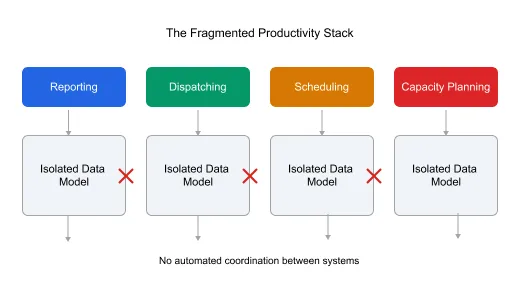
In previous Scheduling articles we described how semiconductor fabs have invested in sophisticated productivity tools that operate in silos, while the industrial engineer serves as the human integration layer. They manually translate insights from reporting into actions in dispatching, reconcile scheduling decisions with capacity plans, and carry institutional knowledge that exists nowhere else.
This model is breaking down. Expertise is retiring faster than it can be replaced, and complexity is growing faster than human capacity to manage it. The integration burden exceeds what people can reliably handle.
The solution isn’t more tools, but rather a different kind of intelligence in the form of AI agents that can reason across systems, act on that reasoning, and scale beyond human limits.
What are AI agents?
The term “AI” carries baggage. Depending on who’s talking, it means chatbots, machine learning models, robotic automation, or science fiction. For fab operations, a specific definition matters.
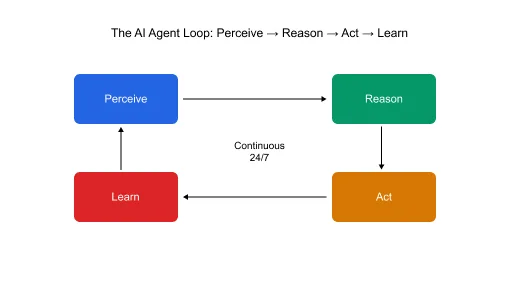
As depicted in Figure 1, an AI agent is software that can:
- Perceive the state of multiple systems—equipment status, WIP positions, schedule commitments, and capacity constraints.
- Reason about cross-functional implications such as, if this tool goes down, what happens to downstream queues? What’s the scheduling impact? What does capacity planning need to know?
- Act within defined boundaries to adjust dispatch priorities, flag scheduling conflicts, and recommend rebalancing actions.
- Learn from outcomes and human corrections to encode the reasoning behind IE overrides, not just the overrides themselves.
This isn’t replacing IEs. It’s scaling IE judgment across the fab 24/7 with perfect consistency and zero fatigue. Think of it as a virtual supervisor—an always-on presence that monitors everything an experienced IE would monitor, reasons the way an experienced IE would reason, and acts within the boundaries that operations defines.
Following are several case studies depicting how AI agents can optimize scheduling.
Use case 1: proactive WIP rebalancing
WIP congestion is one of the most common sources of cycle time variability. In fragmented systems, the pattern is familiar: WIP builds at a constrained tool group, reporting shows queue depths rising, and an IE notices, assesses, and decides whether to intervene (see Figure 2). If she is busy or the buildup is gradual hours can pass before action.
With an AI agent as the integration layer, the sequence changes. The agent continuously monitors real-time WIP positions and models downstream flow: where will congestion appear in four hours? Eight hours? Tomorrow?
When it predicts a bottleneck—before queue depths trigger alarms—it adjusts upstream dispatch priorities, may release holds on alternate routings, and logs the intervention and reasoning. Early pilots have reported 15–20% reductions in WIP variability at monitored tool groups, while IE time shifts from reactive rebalancing to higher-value optimization.
Use case 2: Dynamic scheduling under uncertainty
Scheduling is a plan. Execution is reality. The gap between them is where cycle time commitments go to die.
Traditional scheduling systems optimize against a snapshot of current WIP, expected equipment availability, and forecasted demand. Then reality diverges: a tool goes down, a lot needs rework, and a hot lot arrives. The schedule becomes something operators work around rather than follow.
The response is usually manual. Schedulers assess the disruption, re-run optimization, and push updates to dispatch—a cycle that can take 30 minutes to several hours while dispatch runs on stale information.
An AI agent changes this dynamic. When a tool goes down, it immediately assesses affected lots, downstream impact, and scheduling commitments at risk. Within minutes—not hours—it evaluates alternate equipment, adjusts lot priorities, weighs trade-offs, updates the dispatch queue, and flags capacity implications so planning knows now, not at the next review meeting.
Use Case 3: Knowledge Capture in Action
Tribal knowledge is not mysterious. It is the accumulated reasoning behind thousands of decisions made by experienced staff. The problem is that there is no reliable mechanism to capture it when it is applied.
Consider a senior IE who consistently overrides dispatch recommendations for a specific product-tool combination. When downstream queues cross a threshold, she reduces batch sizes. She can explain why, but that reasoning lives in her head, not in any system.
An AI agent can observe these interventions and learn from them. When an IE overrides a recommendation, the agent captures the fab state, original recommendation, human decision, and outcome. Over time, patterns emerge. The agent proposes a rule. The IE validates or corrects it. The rule enters the system.
This is not AI inferring hidden truths. It is a systematic way to encode judgment humans already exercise to make it visible, testable, and persistent.
Use Case 4: Cross-Layer Optimization
The hardest decisions in fab operations involve trade-offs across time horizons. A dispatch decision that maximizes today’s throughput may create a capacity cliff next week. A scheduling choice that meets this week’s commits may starve a tool group with maintenance scheduled.
Single-layer systems do not see these trade-offs. Dispatch optimizes for now. Scheduling optimizes for this week. Capacity planning optimizes for this quarter. Each system does its job, but the jobs conflict.
IEs resolve these conflicts through judgment and negotiation. That works when the IE has visibility across layers, but fails when complexity exceeds human capacity, the IE is busy, or when the right expertise is unavailable.
An AI agent can maintain awareness across layers. It evaluates dispatch decisions for scheduling impact, scheduling options for capacity impact, and surfaces trade-offs explicitly. One option may maximize throughput today, while another may sacrifice 3% now to avoid a 12% capacity shortfall next week.
The 24/7 Advantage
An agent can monitor the entire fab simultaneously—every tool, lot, and queue—without fatigue, distraction, or shift-to-shift context loss.
This is not about replacing human judgment. It is about extending that judgment to the second shift, the weekend, the auxiliary fab, and the moments when too many problems compete for attention.
Fabs that deploy agent-based integration gain a structural advantage: their best judgment is available everywhere, without the staffing limits of human coverage
What This Requires
AI agents are not a product you install. They are a capability you build—or acquire through the right partner.
The requirements are substantial:
- Data infrastructure: Agents need real-time access to equipment status, WIP, queues, schedules, and capacity constraints. Most fabs have the data; fewer make it available to external systems in real time.
- Domain models: Agents need to understand fab operations—not generic optimization, but the constraints, relationships, and objectives that drive semiconductor manufacturing.
- Action boundaries: Agents that act need guardrails: what can they do autonomously, what requires approval, and how conflicts with human judgment are resolved.
- Feedback loops: Agents improve only when outcomes and IE corrections become signal. Capturing that feedback is what separates agents that learn from agents that stagnate.
- Change management: The operating model changes. IEs shift from operators to supervisors, and the human-system relationship becomes organizational transformation—not just technology deployment.
The Practical Path
Fabs considering AI agents face three choices: build internally, partner with specialists, or wait.
Building internally requires AI expertise most fabs do not have or need as a core competency. Waiting cedes advantage; the learning curve for AI-enabled operations is measured in years.
Partnering offers the fastest path when vendors combine AI engineering with deep semiconductor domain expertise. Generic AI platforms can provide infrastructure; agents that reason correctly about fab operations require domain knowledge built over decades, not months.
FAQs
How can AI agents help reduce cycle time variability in a semiconductor fab?
What is the difference between AI agents and traditional fab scheduling software?
Can AI agents capture tribal knowledge from experienced industrial engineers?
Why do fab productivity tools still need manual coordination?
Many fab tools optimize for specific functions such as reporting, dispatching, scheduling, or capacity planning. Because they operate in separate workflows, engineers must reconcile conflicts and translate insights into action. AI agents help connect those decisions across systems.
What should manufacturers consider before using AI agents in fab operations?
Manufacturers should assess real-time data access, operating boundaries, domain-specific models, feedback loops, and change-management readiness. AI agents work best when grounded in fab expertise and deployed with clear rules for when they recommend, escalate, or act.